Unit
AUTONUM 1-
Railroad
Railroad,
a form of
land transportation in which a locomotive, or self-propelled motor unit, draws a
train of cars over a track of two parallel rails placed on a permanent roadway.
The flanged wheel rolling on iron or steel rails, which involves relatively
little friction, furnishes a very economical and reliable mode of transport.
Railroads have been built in all parts of the world, and more than a hundred
countries each operate a hundred miles (160 km) or more of railway.
Taking into
account declines in some countries, total world mileage is about 775,000
(1,240,000 km)—this figure represents mileage of first train track only and
excludes double trackage and sidings. By continents this is roughly divided as
follows: North America, 36%; Europe, 34%; Asia, 12%; South America, 8%; Africa,
6%; and Australia, 4%.
Roadbed and Track
In all railroad construction the
first consideration is the survey of a feasible route. In determining the
location of early railroads, often a town's eagerness for rail service or
desires of financial backers were important. Once a route was selected,
standards concerning curvature, grades, gauge, and quality of construction were
established. A densely populated area with potentially heavy traffic would call
for better construction with low grades and easy curves, while a sparsely
settled region would probably allow cheaper construction with sharper curves and
steeper grades. The strips of land on which a line is located are called a
right-of-way. They are wide enough for tracks, signals, bridge abutments,
telegraph and telephone lines, sidings, stations, and other necessary buildings.
Since any variance from a level and
straight track causes increases in operating and motive power costs, the ideal
route would have neither curves nor grades. Such trackage, however, is rare. The
longest stretch of straight track in the United States is a 79-mile (126-km)
tangent on the Seabord Airline in North Carolina. The steepest grade or gradient
on a line-haul railroad in the United States is the 5.89% grade ascending the
Ohio River bank at Madison, Ind. Outside the United States the steepest incline
worked without cogs or cables is a 9% grade in France. In the United States
today grades in excess of 2% are rare. The use of cuts, fills, bridges, and
tunnels all help to reduce grades.
To compensate
for the effect of centrifugal force on curves, often the track is banked—that
is, the outer rail is raised 1 inch (2.5 cm) or more. An easement, which
is a track segment with a gradually increased curvature, is generally used
between a tangent and the curve with its elevated outer rail. In setting
standards for maximum grades and curves, most railroads have worked out a
compromise between the costs of original construction and the costs of
operation. Most railroads, in addition, have lowered grades, eased curves, and
even relocated routes as growing population and increased traffic have justified
expenditures.
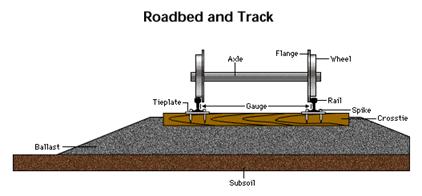 Once
cuts, fill, and bridge approaches are completed, the rough grading of the
roadbed can soon be finished. On this roadbed the track structure consisting of
ballast, crossties, tie plates, rails, and rail connections is built. The
ballast may be crushed rock, slag, gravel, or cinders. During the long era of
steam locomotives, cinders from engine roundhouses were commonly used. Ballast
holds the ties in place, spreads the track load over the area of the subgrade,
and provides good drainage. It also makes a smoother riding track, lessens dust,
and reduces maintenance problems. In much early railroad construction,
especially in the western United States, the track was laid on the rough grade
with a minimum of ballast, but as traffic grew, increased amounts of ballast
became essential.
Once
cuts, fill, and bridge approaches are completed, the rough grading of the
roadbed can soon be finished. On this roadbed the track structure consisting of
ballast, crossties, tie plates, rails, and rail connections is built. The
ballast may be crushed rock, slag, gravel, or cinders. During the long era of
steam locomotives, cinders from engine roundhouses were commonly used. Ballast
holds the ties in place, spreads the track load over the area of the subgrade,
and provides good drainage. It also makes a smoother riding track, lessens dust,
and reduces maintenance problems. In much early railroad construction,
especially in the western United States, the track was laid on the rough grade
with a minimum of ballast, but as traffic grew, increased amounts of ballast
became essential.
Before any rail can be laid, the
track gauge, the distance between the inside faces of the two rails, must be
decided. The first successful railroads in England used steam locomotives built
by George Stephenson to operate on tracks with a gauge of 4 feet 8.5 inches
(1.41 meters), probably because that was the wheel spacing common on the wagons
and tramways of prerailroad England. This gauge quickly became standard in
England by act of Parliament and soon was common in much of the United States. A
century ago the 5-foot (1.5-meter) gauge was common in the South, and in 1871
more than 20 different gauges existed in the United States. Nevertheless, by the
1880s the 4-foot 8.5-inch gauge was becoming standard.
The railroads of the world have
used a variety of gauges ranging from 2 feet (60 cm) to as much as 8 feet (2.4
meters). But standard gauge is virtually universal in North America and much of
Europe and is used by about 60% of the world's railways.
Source:
"Railroad." Encyclopedia
Americana. Grolier Online
http://ea.grolier.com/cgi-bin/article?assetid=0327770-00 (accessed August
13, 2007).